
Avoid Traveler’S Diarrhea India: India Traveler’s Diarrhea Prevention: The 2026 Food and Water Protocol

Most people think traveler’s diarrhea in India is caused by spicy food. It isn’t. The actual culprit is fecal-oral contamination of water and food, usually from a specific subset of bacteria: enterotoxigenic E. coli (ETEC), Campylobacter, Shigella, and Salmonella. The spice is innocent. The unwashed coriander on top of your curry is not.
This guide covers what actually works. Not the generic “drink bottled water” advice that fails when you brush your teeth with tap water or eat a salad rinsed in it. We’ll get into specific water purification tools, the food rules that matter, and the antibiotic decision that most travelers get wrong.
Why India Breaks the Usual Traveler’s Diarrhea Rules
India is not Southeast Asia. The bacterial load in the environment is higher, the sanitation infrastructure is patchier, and the street food culture is more central to the experience. A backpacker in Thailand might get away with eating pad thai from a night market. In India, that same risk calculus shifts.
The CDC estimates that 30-70% of travelers to India will experience at least one episode of traveler’s diarrhea. That’s not a scare statistic. It’s the reality of a country where 500 million people still practice open defecation in some regions and where municipal water treatment is inconsistent.
But here’s the thing: you can avoid it. Not by hiding in five-star hotels and eating only at the Oberoi. You can eat street food, take trains, and drink chai from clay cups. You just need a protocol.
The Water Protocol: Purification Tools That Actually Work
Bottled water is the baseline. But it fails in three ways: the seal is broken, the brand is counterfeit, or you use it for everything and forget that ice, rinsed fruit, and toothbrush water are all vectors.
SteriPEN Ultra UV Purifier
The SteriPEN Ultra ($99) uses UV-C light to destroy 99.9% of bacteria, viruses, and protozoa in 48 seconds. It works on 1 liter at a time. The problem: it needs batteries and doesn’t filter sediment. Murky water blocks UV light. You need to pre-filter with a bandana or coffee filter if the water is cloudy.
Grayl GeoPress Purifier Bottle
The Grayl GeoPress ($99.95) is the best all-in-one option for India. It’s a 24 oz bottle with a press mechanism. You fill it, press down for 8 seconds, and the water passes through an electroadsorptive filter that removes 99.9999% of bacteria, 99.999% of viruses, and 99.999% of protozoa. It also removes heavy metals and chemicals. No batteries, no waiting, no separate filter. The downside: the filter cartridge lasts for 65 gallons, which is about 3 months of daily use. For a 2-week trip, that’s fine.
Aquatabs Chlorine Dioxide Tablets
Aquatabs ($12 for 100 tablets) are the budget option. One tablet treats 1 liter of water in 30 minutes. They kill bacteria and viruses but not Cryptosporidium. For India, where bacterial contamination is the main risk, they work. The taste is slightly chlorinated, but less than iodine tablets.
Bottom Line: Buy the Grayl GeoPress if you want one tool that handles everything. Buy Aquatabs if you’re on a tight budget and will mostly drink bottled water with tablets as backup.
The Food Rules: What Actually Causes Delhi Belly
Water is only half the equation. Food is the other half. And the food rules are more nuanced than “don’t eat salad.”
- Eat at busy places. High turnover means food hasn’t been sitting out. A street food stall with 20 locals queuing is safer than an empty restaurant with a laminated menu.
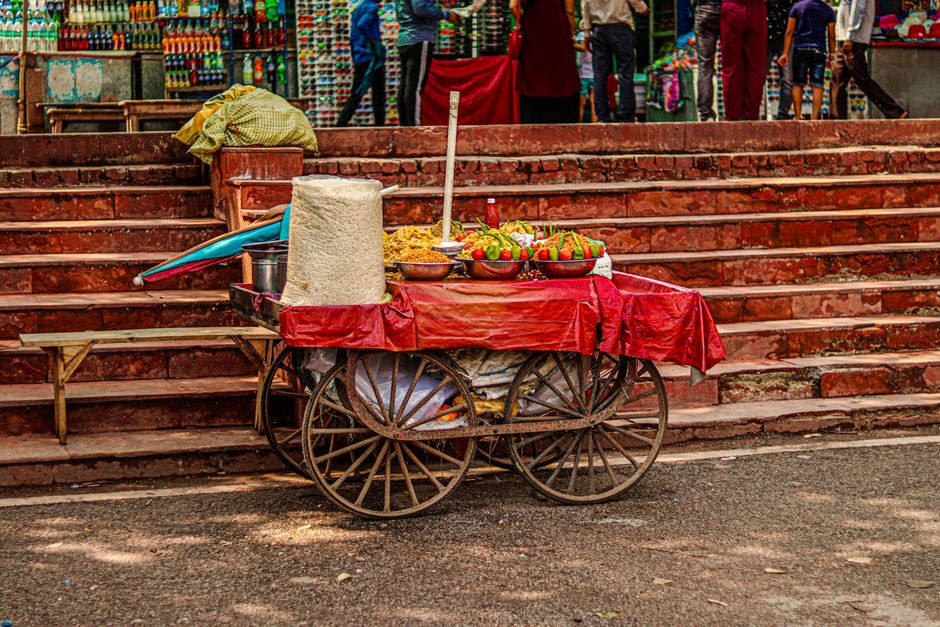
- Watch the cooking. If you can see the food being fried, grilled, or boiled in front of you, the heat is killing bacteria. Samosas, pakoras, jalebi, grilled corn — these are safe bets.
- Avoid raw garnishes. The coriander, mint chutney, and sliced onions on top of your food were likely washed in tap water. Ask for your food without them, or scrape them off.
- Peel it yourself. Bananas, oranges, mangoes, lychees — fruits with thick peels are safe. Apples and grapes are not, unless you wash them with purified water yourself.
- Skip the ice. Unless you’re at a high-end hotel or a restaurant that explicitly uses filtered water for ice, assume it’s tap water.
- Dairy is a gamble. Paneer and yogurt are usually made from pasteurized milk in commercial settings, but street-side lassi can be risky. If you want lassi, get it from a busy shop and watch them make it.
One rule I follow strictly: no raw vegetables after 6 PM. By evening, food that was prepared in the morning has been sitting out in the heat. The risk compounds. Lunch is safer than dinner for raw foods.
The Antibiotic Decision Most Travelers Get Wrong
Here’s the controversial part. Many travel clinics prescribe azithromycin (Zithromax) or rifaximin (Xifaxan) as a “just in case” antibiotic for India. The assumption is that you’ll get sick and need to self-treat.
That assumption is wrong for most travelers.
Antibiotics are not preventive. They are treatment. Taking azithromycin prophylactically is a bad idea — it wrecks your gut microbiome, increases antibiotic resistance, and doesn’t guarantee protection. The CDC does not recommend prophylactic antibiotics for most travelers.
What you should do instead:
- Pack bismuth subsalicylate (Pepto-Bismol). The chewable tablets or liquid. Studies show that taking 2 tablets 4 times daily reduces the risk of traveler’s diarrhea by about 60%. It’s not an antibiotic. It’s a mild antimicrobial and anti-inflammatory that coats the gut. The side effect: black tongue and black stools. Harmless, but alarming if you don’t know.
- Pack oral rehydration salts (ORS). The WHO formula. Sachets cost pennies in India. Mix with purified water. This is the most important thing you can pack, because dehydration is what lands travelers in Indian hospitals, not the diarrhea itself.
- Pack loperamide (Imodium) for emergencies only. If you have a 12-hour train journey and diarrhea hits, loperamide will stop the symptoms. But it doesn’t treat the infection. It just paralyzes your gut. Use it only when you need to travel, not as a cure.
If you do get a severe case — blood in stool, fever above 101°F, symptoms lasting more than 48 hours — go to a doctor in India. Private hospitals like Apollo or Fortis are excellent and cheap compared to the US. A consultation costs $10-20. They’ll prescribe the right antibiotic based on local resistance patterns, not a guess.
Comparison: Water Purification Methods for India
| Method | Cost | Kills Bacteria | Kills Viruses | Kills Protozoa | Speed | Best For |
|---|---|---|---|---|---|---|
| Grayl GeoPress | $99.95 | 99.9999% | 99.999% | 99.999% | 8 seconds | All-around travel, daily use |
| SteriPEN Ultra | $99 | 99.9% | 99.9% | 99.9% | 48 seconds | Clear water sources, backup |
| Aquatabs | $12/100 | 99.99% | 99.99% | Not effective | 30 minutes | Budget travel, backup to bottled water |
| Bottled water (Bisleri, Kinley) | $0.30/liter | Varies | Varies | Varies | Instant | Baseline, but check the seal |
One note on bottled water in India: Bisleri is the most trusted brand, but counterfeit bottles are common. Check the seal. A broken seal or a bottle that looks refilled is a red flag. Kinley (Coca-Cola) and Aquafina (PepsiCo) are also widely available and less frequently counterfeited.
The Probiotic Question: Do They Help?
Short answer: probably not for prevention. The evidence is mixed. Some studies suggest that Saccharomyces boulardii (a yeast probiotic, sold as Florastor) may reduce the risk of traveler’s diarrhea by about 10-20%. Lactobacillus strains show less consistent results.
If you want to try, start taking Florastor ($25 for 50 capsules) 2-3 days before departure and continue through the trip. But don’t rely on it as your primary defense. Water purification and food rules matter more.
What about eating local yogurt? The theory is that local probiotics colonize your gut. The reality is that commercial yogurt in India is pasteurized, which kills most of the beneficial bacteria. And street yogurt carries the same contamination risk as any dairy product. Skip it.
What to Do When Prevention Fails
Despite everything, you might still get sick. It happens. Here’s the protocol.
First, assess severity. Mild diarrhea (3-4 loose stools per day, no fever, no blood) is uncomfortable but not dangerous. Treat with ORS and bismuth subsalicylate. Continue eating bland foods — rice, bananas, plain toast, boiled potatoes. Avoid dairy, alcohol, and spicy food for 48 hours.
Moderate diarrhea (5-8 stools per day, mild fever, cramps) warrants a doctor visit. In India, you can walk into any Apollo Pharmacy and ask for a consultation. The pharmacist will likely recommend an antibiotic like azithromycin (500 mg once daily for 3 days) or ciprofloxacin (500 mg twice daily for 3 days). Note: ciprofloxacin resistance is rising in India, so azithromycin is the preferred first-line treatment now.
Severe diarrhea (blood in stool, fever above 101°F, signs of dehydration like dizziness or reduced urination) requires a hospital visit. Go to a private hospital, not a government one. The care is faster and the cost is still low — $50-100 for a full workup and IV fluids.
The mistake to avoid: taking loperamide when you have a fever or blood in your stool. Loperamide slows gut motility, which traps the bacteria inside and can make the infection worse. It’s only for mild, non-febrile diarrhea when you need to travel.
Traveler’s diarrhea in India is a solvable problem. The tools exist. The protocols are clear. What’s missing is execution — the discipline to use purified water for everything, to skip the raw garnish, to resist the antibiotic unless you actually need it. Most people who get sick made one of those three mistakes. Don’t be one of them.
Most people think traveler’s diarrhea in India is caused by spicy food. It isn’t. The actual culprit is fecal-oral contamination of water and food, usually from a specific subset of bacteria: enterotoxigenic E. coli (ETEC), Campylobacter, Shigella, and Salmonella. The spice is innocent. The unwashed coriander on top of your curry is not. This guide…