
Stroller-Friendly City Loops That Skip Steep Stairs


The best stroller day in a city is not the one with the most attractions. It is the loop that gets you back to your starting point without a surprise staircase, a dead-end platform, or a tired child two miles from the nearest lift. After planning family walks in old city centers, I now build routes around exits, surfaces, toilets, and recovery points first.
Why stairs break an otherwise good city loop
Stairs are not just a small inconvenience when you push a stroller. They change the whole route. A staircase can force you to carry a 12-kilogram stroller, wake a sleeping child, separate one adult from the rest of the group, or send everyone onto a busy road with no safe crossing. The route may look short on a map and still feel impossible on foot.
Flat does not mean easy
A route can have no steep hill and still fail families. Cobblestones shake the seat, narrow pavements make passing difficult, and a ramp with a sharp turn can be harder than four ordinary steps. I look for a clear walking width of at least 1.5 metres, smooth paving, and crossings that do not require crossing three lanes of traffic. A gentle slope is usually fine; a long slope with no bench is not.
The loop needs an escape point
Every good route has at least two places where you can shorten the day. A public transport station with a lift, a museum courtyard, a covered market, or a large café can act as an exit. Mark these points before leaving. My strongest rule is simple: never plan a stroller loop that only works if the child stays cheerful, the weather holds, and every lift is open.
Verdict: Choose a route with predictable surfaces and several exit points, even if it misses one famous viewpoint. Reliability beats a perfect postcard.
Three city-loop patterns that work with a stroller
Match the loop to the day you actually have
These patterns are more useful than copying a famous sightseeing route. Distances are approximate walking distances, and the timing assumes one adult pushing a stroller with regular stops.
| Loop pattern | Best distance | Useful stop | Main risk | My verdict |
|---|---|---|---|---|
| Park, market, riverfront, park | 2.5 to 4 km | Toilet and café at the market | Crowds at lunchtime | Best first choice for toddlers |
| Museum, plaza, covered arcade, station | 1.5 to 3 km | Indoor rest every 45 minutes | Lift closure at the station | Best for rain or nap schedules |
| Hotel, historic center, waterfront, hotel | 3 to 5 km | Hotel room as a reset point | Cobblestones and tourist crowds | Best for confident walkers |
| Suburban station, playground, bakery, station | 2 to 3.5 km | Playground before the return train | Infrequent transport | Best when the center is too steep |
Pick one pattern and protect the exit
The park-to-market loop is my clear winner for a first day. It gives a child space to move, gives adults a predictable food stop, and leaves several ways to cut the walk short. I would choose it over a dense old-town loop with better architecture but no toilets, shade, or step-free escape.
Do not confuse a short route with a low-effort route
A 2-kilometre cobblestone route can be harder than a smooth 5-kilometre river path. Surface, shade, crossings, and stop frequency matter more than the number on the map.
Questions to ask before choosing a neighborhood

The neighborhood itself decides how much improvisation a stroller day allows. A modern waterfront district may have longer distances but wide pavements and reliable lifts. A beautiful historic center may have short blocks, steep streets, and entrances that change from one side of the plaza to the other. I choose the place that gives me more ways to recover.
Does the area have step-free public transport?
Check the station map, not just the line map. Look for the lift symbol at the exact entrance and confirm that the lift reaches the platform you need. Some stations have an accessible entrance several blocks away, and some require a staff member to unlock a gate. Add ten minutes to the plan when using an unfamiliar system.
Can you find a toilet every 60 to 90 minutes?
Restaurants may refuse non-customers, and small cafés may have toilets upstairs. Museums, department stores, transport hubs, and large public libraries are safer choices. Save two options because opening hours change and a queue can turn a quick stop into a meltdown.
Where can the child move safely?
A stroller day should include a place where the child can walk without dodging bicycles. Look for fenced playgrounds, pedestrian squares, quiet courtyards, and car-free promenades. My verdict is to choose a less famous district with one dependable play space over a landmark-heavy route that keeps the child strapped in for three hours.
The stroller matters, but the route matters more
My strong opinion: do not buy a huge all-terrain stroller to solve a route-planning problem. Large wheels help on broken paving, but extra width and weight can create new problems at lifts, buses, café doors, and hotel corridors. The route should decide the stroller category, not the other way around.
When a compact stroller is the better travel tool
The UPPAbaby MINU V2 weighs 16.9 pounds and folds to 11.5 by 20.3 by 23 inches. That makes it a sensible example for cities with frequent lifts, narrow restaurant entrances, and occasional folding on public transport. The tradeoff is clear: small travel wheels are easier to carry but less comfortable on deep cobbles. For smooth pavements and rail-based trips, I prefer this compact format. The manufacturer’s specifications are available on the UPPAbaby MINU page.
When rough surfaces justify more weight
The Baby Jogger city mini GT2 weighs 22.4 pounds and uses all-terrain rubber tires with suspension. The Thule Spring 2 weighs 23.8 pounds, has 8.5-inch foam-filled tires, and folds to 19.5 by 17.7 by 15.3 inches. These examples make sense for uneven pavements, parks, and longer outdoor loops, but I would not choose either solely because a city has one steep staircase. A heavier stroller still needs to be carried. Check the Baby Jogger city mini GT2 specifications and Thule Spring 2 specifications before comparing models.
Verdict: For lift-heavy city travel, choose the lightest stroller that handles your actual surfaces. For sustained rough paving, accept extra weight for better control, but never mistake suspension for stair access.
Mistakes that turn a flat route into a bad day
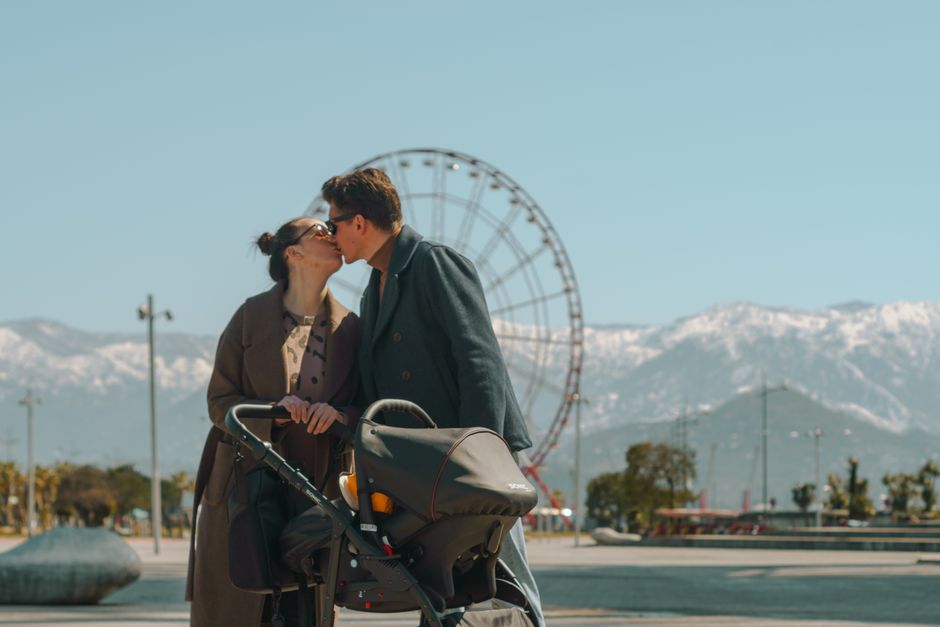
Most stroller failures come from small planning errors rather than impossible terrain. These are the mistakes I now remove before leaving the hotel.
Five problems to catch early
- Trusting the first station entrance: the nearest entrance may use stairs while the accessible entrance sits around the block.
- Planning by landmark distance: “500 metres from the museum” says nothing about paving, crossings, or the slope after the museum.
- Ignoring temporary closures: lift maintenance, roadworks, festivals, and parade barriers can erase the route you checked yesterday.
- Carrying too much: a full backpack makes a short staircase unsafe. Pack one water bottle, a compact rain cover, snacks, and a small changing kit, then refill locally.
- Leaving the return too late: the last kilometre feels much longer when the child is hungry and the adults are carrying souvenirs.
Fix the route before fixing the gear
If the walk feels difficult on the map, first remove a landmark, add a transport exit, or split the day into two loops. Buying a larger stroller rarely fixes a missing lift or a closed pavement. I would rather take a clean 2-kilometre route, return to the hotel for a nap, and go out again than force a 6-kilometre sightseeing circuit because it looked efficient.
Clear rule: if one failure can strand the group, the route is not ready. Add a second exit before adding another attraction.
My best formula for a first stroller day
Start with a park, finish near your hotel, and keep the first loop under 4 kilometres. That formula gives the child room to move, gives the adults a familiar reset point, and leaves enough energy for a second outing if the day goes well.
A practical morning plan
Leave after breakfast with the child rested. Walk to the park using the flattest entrance, spend 30 to 45 minutes there, then continue to a market or large café with a known toilet. After food, choose one nearby landmark. Do not add a second major attraction unless the group still has energy. Return by the same broad route or use the pre-checked step-free station. Keep the last section boring on purpose.
When not to force a city loop
Skip the loop when severe rain, heat, a lift outage, or a child who needs a long nap has removed the safety margin. Use one destination with indoor toilets and transport nearby instead. A museum beside an accessible station can deliver a better day than a famous old town that demands stairs, steep alleys, and constant carrying.
The future of family city travel will belong to routes that publish more than landmark names. Clear lift locations, pavement conditions, toilet access, and honest detours would let parents plan with confidence before they arrive. Until cities provide that detail consistently, a short tested loop remains the most dependable way to see more without carrying the whole day on your back.
The best stroller day in a city is not the one with the most attractions. It is the loop that gets you back to your starting point without a surprise staircase, a dead-end platform, or a tired child two miles from the nearest lift. After planning family walks in old city centers, I now build…